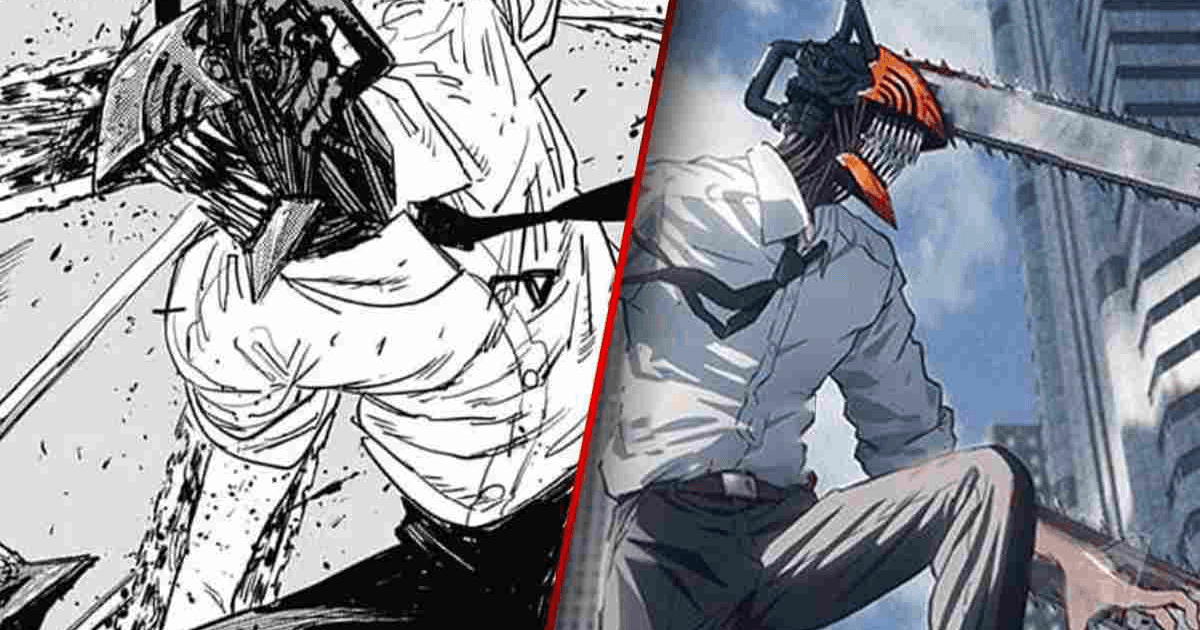
Spoiler scope: Full Chainsaw Man Part 1 manga (chapters 1–97) and the entirety of MAPPA's twelve-episode adaptation. No spoilers from Part 2.
MAPPA's Chainsaw Man arrived in October 2022 with a level of pre-release attention almost no recent shōnen adaptation has matched. Tatsuki Fujimoto's manga had become, by the time of its first ending, the most-discussed Shōnen Jump release in years; MAPPA had assembled a director (Ryū Nakayama, his first TV series) and an animation roster designed for it.
The resulting twelve episodes are, at the panel level, one of the most faithful adaptations of a Jump manga in the modern era. There are very few changed lines, no skipped chapters, and almost no anime-original content. And yet the show plays differently from the manga in a way that is hard to articulate without comparing scenes side by side.
This piece is that side-by-side comparison. We're going through the changes that actually change the experience — not the cosmetic differences. There are roughly seven of them.
Change one: the imageboard tone is replaced with a film tone
Fujimoto's manga is famously full of cinematic references, sight gags and panel transitions that imitate film grammar. MAPPA's response is to lean fully into the film register — and quietly drop the more cartoonish, image-board-driven beats that punctuate the manga.
The most visible example is in Episode 1's encounter between Denji and the Zombie Devil. In the manga, Denji's death is staged in a series of explicitly "manga-y" panels: the chainsaw bursting through his skull is framed straight-on, with sound effects inside the panel and a small amount of stylised exaggeration. The anime version is deliberately quiet — sustained, near-silent shots of a body, then a slow chainsaw rev. The same beat plays as horror instead of as a joke.
The choice has consequences across the series. The fish-bowl gag with the Sea Cucumber Devil in Episode 2 plays, in the manga, as broad slapstick; in the anime it is handled with restraint and almost-realistic lighting. The audience laughs less and feels the violence more. This is the single biggest tonal difference between the two versions and it is intentional.
Change two: Power's introduction is reframed as a threat
In Chapter 6 of the manga, when Power first appears, she is introduced through a half-page splash of her in mid-action against the Bat Devil — chaotic, bloody, immediately funny. The audience reads her, from the first panel, as an ally who happens to be unstable.
The anime, in Episode 4, stages the same scene differently. Power's introduction is held back: the audience sees the aftermath of her violence (a bystander who has had their face removed) before they see her face. By the time Power appears on-screen, the show has already framed her as someone capable of harm. Her subsequent silliness lands as a tonal twist on top of an established threat.
The reframe is small but important. Fujimoto's Power is funny first and dangerous second; the manga's Power is fundamentally a comedy character whose violence we tolerate. The anime's Power is dangerous first and funny second — a slightly different load-bearing for the same character. Whether you prefer one over the other is taste, but they are different shows.
Change three: Aki's flashbacks are sequenced differently
Aki Hayakawa's backstory — the death of his family at the hands of the Gun Devil — is delivered in a single concentrated flashback in Chapter 23 of the manga. The anime moves the same content earlier, redistributing it across Episode 5 in shorter, layered cuts.
The change makes Aki's grief a structural presence in his early appearances rather than a sudden reveal. By the time we get to the Gun Fiend arc in the manga, we have known Aki long enough to find his trauma surprising. By the time the same arc would arrive in a hypothetical Season 2 of the anime, we will have known Aki through his trauma since Episode 5. This is an editorial choice, not a fidelity issue, and it changes the emotional shape of his arc.
Change four: Makima is staged for re-watch
The single most discussed adaptation choice in the show is Makima. In the manga, Makima is initially read by both Denji and the audience as a benevolent handler — almost a maternal figure to a stray dog. The horror of Makima's actual role is delivered slowly, mostly through what other characters say about her around her absence.
The anime stages Makima from her first appearance with deliberate, low-key signs that something is wrong. The first time we see her — in Episode 1 — she is silhouetted, eating in front of a window, and her dialogue is composed of slightly-too-perfect kindness. The composition is almost identical to the manga panel, but the addition of seconds of held silence reframes her into someone who is, very obviously to a re-watcher, performing.
The trade is real. A first-time anime viewer is more likely to suspect Makima earlier than a first-time manga reader did. Whether that is good adaptation or not depends on how you value first-read surprise versus thematic clarity. We tend to think the anime's choice rewards the rewatch and that the manga's choice rewarded the first read. Both are legitimate and they produce different shows.
Change five: the soundtrack carries weight the manga gives to silence
Kensuke Ushio's score — particularly the standalone tracks released for the show — is doing significant emotional work the manga can't do. In particular, the use of the track First Death in Episode 6 (Himeno's drinking scene) and Asa in the Katana Man fight are doing something the manga does with whitespace and panel size.
The score is not a flaw — it is one of the show's greatest strengths — but it is a different mechanism. Manga readers will notice that scenes which sat in silence on the page are now scored, and scenes that were musical in their pacing on the page sometimes play more quietly on screen. It's a translation, not a one-to-one match.
Change six: the closing-song-per-episode device
The decision to use a different ending song every episode is anime-original and has no manga equivalent. There are twelve unique closing sequences, each with its own song from a different artist. The device is both a marketing decision (it gave the show twelve charting singles) and a tonal one (each ending is a small standalone short film, often re-staging the events of the episode).
Episodes are now, for anime viewers, associated with specific songs. Time Left for the Eternity Devil. First Death for Himeno. Hawatari Nioku Centi for the Katana Man arc. The manga had nothing like this; the anime essentially adds a twelve-song concept-album coda to a story that, on the page, was paced differently.
Change seven: the Katana Man arc compresses
The largest structural compression in the season is the Katana Man arc in Episodes 9–11. The manga gives this arc roughly fifteen chapters; the anime gives it three episodes. A small number of crowd shots, flashbacks and side-character moments are trimmed.
The arc still works — it is, by some measure, the season's high point of action staging — but readers of the manga will notice fewer beats around Akane Sawatari and slightly less time with the side cast at the train station. None of these losses are critical. They are visible if you know to look for them.
What MAPPA chose not to change
The list of things the adaptation does not change is, on balance, longer and more important than the list of changes:
- Every major fight is staged with the same blocking as the manga.
- Every important line of dialogue is preserved.
- Pochita's design, animation and onomatopoeia are intact.
- The recurring food-and-jacket beats — Denji's small wishes — are kept verbatim.
- The ending of the season's Katana Man arc lands on the same image the manga lands on.
How to read the two versions side by side
If you've watched the anime and want to read the manga, start at Chapter 1 — the adaptation is faithful enough that you'll get the same plot, but the manga's panel rhythm, sight gags and use of empty space are genuinely different reading experiences from the show. The adaptation is its own work. The manga is not redundant.
If you've read the manga and skipped the anime because of online discourse about CG or pacing, we'd recommend revisiting Episodes 1, 6, and 9 specifically. They are the show at its strongest, and they make a credible case that the adaptation is a different but legitimate translation of the same source.
Last updated: April 2026.