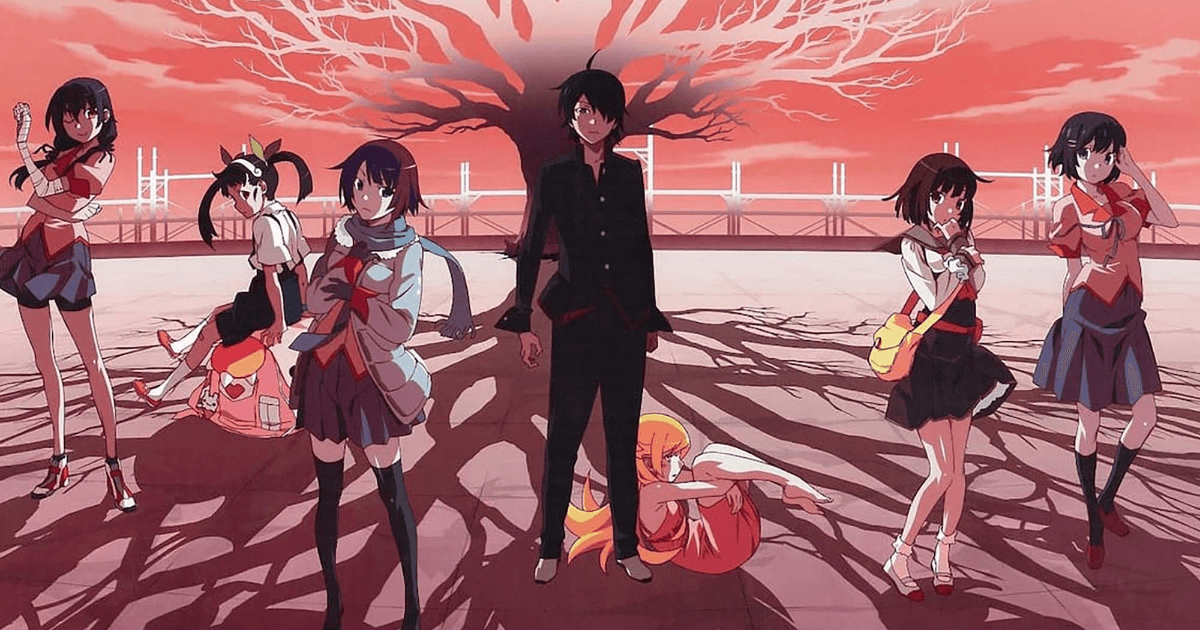
Spoiler scope: No spoilers beyond what's in episode titles and opening credits.
The Monogatari series is one of the longest-running and most narratively ambitious shows in modern anime — and it is, by a significant margin, the franchise most likely to send a new viewer into a state of paralysed indecision. The shows are produced by SHAFT under director Akiyuki Shinbo, the source novels are written by Nisio Isin in clusters, and the anime entries air in the order SHAFT chooses, not the order Nisio Isin published the novels, and not the order the story actually happens in.
There are, accordingly, three watch orders that get debated online: chronological, release, and a hybrid path. We've used all three over the years. Below is the order we currently recommend to a new viewer in 2026.
The short answer
Watch in release order, with one specific exception (Kizumonogatari) inserted as a prequel. That order is:
- Bakemonogatari (2009)
- Nisemonogatari (2012)
- Nekomonogatari: Black (2012)
- Monogatari Series Second Season (2013) — covers Neko White, Kabuki, Otori, Onimonogatari, Koimonogatari
- Hanamonogatari (2014)
- Tsukimonogatari (2014)
- Owarimonogatari (2015)
- Kizumonogatari film trilogy (2016–2017) — or watch this between Bakemonogatari and Nisemonogatari if you want chronology
- Owarimonogatari Second Season (2017)
- Zoku Owarimonogatari (2018–2019)
- Monogatari Series: Off & Monster Season (2024–)
Why release order is the right answer
SHAFT and Nisio Isin worked together on the novel-to-anime sequencing. The information that gets revealed in Bakemonogatari's second arc is, in the original novels, presented later in the timeline — the anime's first season is structured around delaying that information for impact. Watching Kizumonogatari first, in chronological order, gives away a major mystery Bakemonogatari is built around hiding.
The release-order path also tracks how the production team escalates the show's visual grammar. Bakemonogatari is restrained, dialogue-driven and famously fond of single-frame title cards. By Nekomonogatari Black, the show has invented its current visual register; by Monogatari Series Second Season it is at the height of its powers. Watching it in release order shows you a studio teaching itself how to adapt one of the densest pieces of dialogue prose in modern Japanese fiction.
Where chronology actually helps
The one strong argument for chronological order is the Kizumonogatari trilogy. Kizu is set before Bakemonogatari and explains how the protagonist Koyomi Araragi met the vampire Shinobu (then known as Kiss-Shot Acerola-Orion Heart-Under-Blade). The novels were written first; the films were produced almost a decade later because of long production delays at SHAFT.
If you watch Kizu first, you understand the Araragi-Shinobu relationship in detail before Bakemonogatari ever shows it. If you watch Kizu after, you watch Bakemonogatari with the same delicious uncertainty its Japanese audience had in 2009 — you know something happened, you can guess at it, and you don't get the full picture for years.
Both choices are defensible. Our recommendation is to watch Kizumonogatari after Owarimonogatari, where the films were originally screened in the international release window. If you have a strong preference for chronology, watch Kizu between Bakemonogatari and Nisemonogatari — that is the lowest-cost detour and it doesn't damage anything significant.
What's covered in each entry
Bakemonogatari (2009)
Twelve episodes plus three OVA episodes. Five arcs introducing Senjogahara, Hachikuji, Kanbaru, Sengoku and Hanekawa. This is the show's stylistic and thematic introduction — long, dense conversations between teenagers about apparitions that are, structurally, manifestations of the speaker's emotional problems.
Nisemonogatari (2012)
Eleven episodes. Two arcs centred on Araragi's sisters, Karen and Tsukihi. This is the entry most often debated — it is the show at its most provocative and its most divisive. It is also tightly written, despite the reputation.
Nekomonogatari: Black (2012)
Four episodes. A single arc set during the Golden Week between Kizumonogatari and Bakemonogatari's opening. It is a flashback, but it is structured to function on its own and to recontextualise Tsubasa Hanekawa.
Monogatari Series Second Season (2013)
Twenty-six episodes covering five arcs: Tsubasa Tiger, Mayoi Jiangshi, Sodachi Riddle... no wait, sorry — Nekomonogatari: White, Kabukimonogatari, Otorimonogatari, Onimonogatari and Koimonogatari. Most longtime fans consider this the show's peak. Each arc is told from a different protagonist's first-person perspective, including ones that are not Araragi.
Hanamonogatari (2014)
Five episodes. A single arc told entirely from Suruga Kanbaru's perspective, set after the rest of the franchise. If you want the show's most visually disciplined hour, it's the third episode of Hanamonogatari.
Tsukimonogatari, Owarimonogatari (2014–2015)
Four and twelve episodes respectively. Owarimonogatari Season One adapts three arcs and finally explains where the rest of the series has been heading.
Kizumonogatari trilogy (2016–2017)
Three theatrical films. The vampire prequel. The films were eventually re-cut into a single TV-series version (Kizumonogatari: Koyomi Vamp, 2024) which is the most accessible way to watch them today.
Owarimonogatari Second Season (2017)
Seven episodes. Adapts the remainder of Owarimonogatari's novel content. This is the franchise's first emotional climax.
Zoku Owarimonogatari (2018–2019)
Six episodes. Adapts the post-graduation epilogue novel. It is structurally a coda — most viewers treat the franchise as essentially complete after this.
Off & Monster Season (2024–)
The latest entry, adapting Nisio Isin's continuation novels. It is, intentionally, a quieter and more retrospective series. Best watched after everything above.
Common mistakes new viewers make
- Starting with Kizumonogatari because it's chronologically first. The films were made on the assumption you'd already seen Bakemonogatari. The visual grammar, the recurring jokes, and the casting of Shinobu's mature voice (Maaya Sakamoto) all build off prior knowledge.
- Skipping Nisemonogatari. The show's reputation has scared off some viewers, but the next four entries assume you've seen it.
- Treating Hanamonogatari as skippable. It is short, gorgeous, and crucial for Kanbaru's arc. Don't.
- Watching Off & Monster Season early. The new series will not work as an introduction. It is built for returning viewers.
If you only have time for the first season
If you want to test whether the franchise is for you, watch the first three arcs of Bakemonogatari — that is six episodes. If the dialogue rhythm and the title cards work for you by Episode 3, you will be fine for the next ninety hours. If they don't, the rest of the series is going to be a struggle.
Last updated: April 2026.