Spoiler scope: Light spoilers through Episode 28 of the first season; no manga spoilers beyond the published anime arcs.
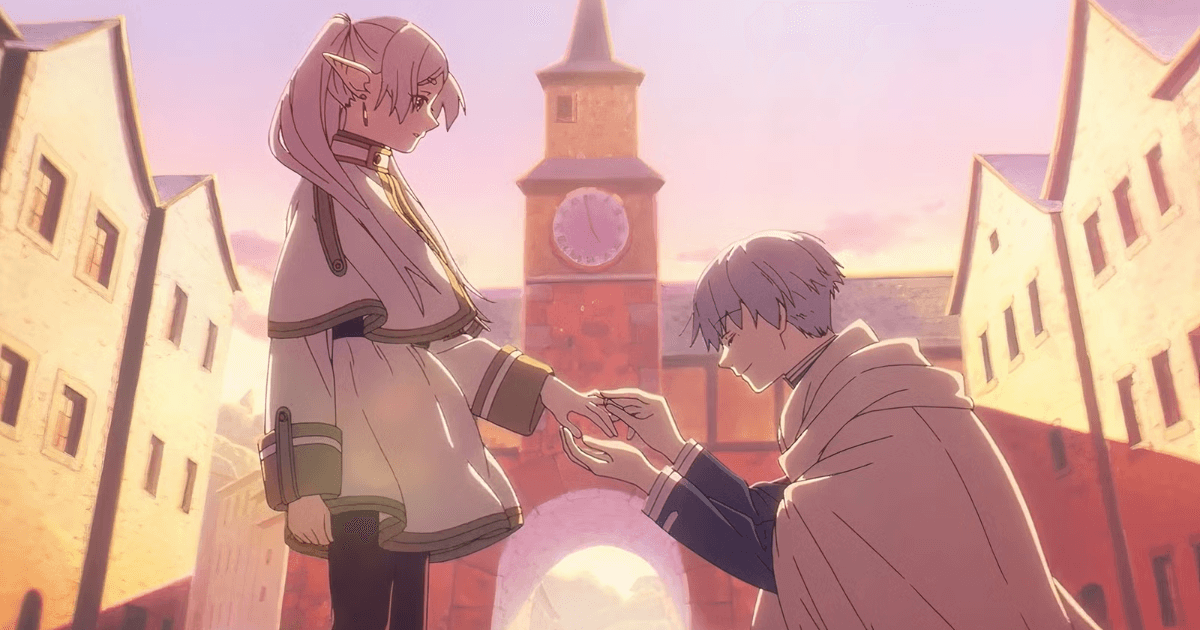
The first sequence of Frieren: Beyond Journey's End spends almost no time on what should be the show's defining event. The Demon King is dead. Himmel, Heiter, Eisen and Frieren — the four heroes who killed him — return to the capital, watch a meteor shower together, and part ways. Frieren, an elf, promises Himmel she'll return in fifty years. She returns in fifty years. Himmel is an old man. Then Himmel dies.
Most fantasy anime would treat this as the prologue. Frieren treats it as the entire show. The next twenty-seven episodes are about an elf walking back through the same continent, in the same season, looking at the same statues — and slowly understanding that she did not pay attention to her friends while they were alive.
A series built on what the camera doesn't show
Director Keiichirō Saitō and Madhouse's storyboards consistently choose restraint where most fantasy adaptations would choose spectacle. The Demon King fight is not animated; it is described in passing. The sequence where Himmel dies — the most consequential scene in the entire premise — is told through a funeral, a small flashback, and a single shot of Frieren crying into Heiter's shoulder while admitting she "barely knew anything about him."
The decision to skip the dragon-slaying years and dwell on what comes after them is genuinely radical for the genre. Most isekai and high-fantasy adaptations are structured as escalation: a bigger dungeon, a stronger demon, a better sword. Frieren begins with the maximum stakes already cleared, and asks a question fantasy rarely sits with — once you have done the heroic thing, what do you do with the next thousand years?
The answer the show offers is patient and unflashy: you walk back through the locations of your old adventure, and you let the present rhyme with the past. Episode 9's hide-and-seek with the village children is, structurally, an echo of the same game the original party played at an inn decades earlier. Frieren wins the modern game by sitting in a tree for hours, the way she had once before — but this time, no one is alive who remembers playing it with her.
Grief that arrives on a delay
Frieren is roughly a thousand years old. To her, ten years feels like an afternoon; fifty years is a casual promise. The series takes this premise — an elf who outlives everyone — and uses it not as a power fantasy, but as a slow-developing wound.
The show's central emotional engine is that Frieren did not register the importance of Himmel until a century after he died. When Heiter, the priest of the original party, asks her on his deathbed why she is bothering to stay with him, she answers honestly: she does not know. She is curious about humans. She has time. She is not yet sure she loved them.
That single line of dialogue — that she is not yet sure — is what gives the series its specific kind of ache. Frieren is not in denial. She is not heartbroken in any way she can articulate. She is an elf who is taking decades to discover, in the slow and accidental way her species discovers things, that the ten years she spent with three short-lived humans were the most important ten years of her life.
By Episode 25, when she stands in front of a statue of Himmel and asks Fern to take a photograph, the audience has watched her travel for two and a half cours to arrive at one small admission: she should have looked at him more carefully when he was alive. The line, when it lands, is not theatrical. It is a quiet, almost throwaway moment between two travelling companions in a town square. The camera doesn't push in. The score doesn't swell. Frieren's emotional climaxes are designed to feel, deliberately, like ordinary days.
Why the pacing works
A common early objection to Frieren was its tempo. The show takes thirteen episodes to fully introduce its supporting party, and the first significant external conflict — the Mage Examination arc — does not arrive until well past the midpoint. For viewers used to seasonal fantasy anime that spend the first three episodes establishing the mission, this feels like the show is doing nothing.
It is not. Frieren is using its time budget to stage the show's central problem: time itself. The series cannot sell its premise — that Frieren has been alive long enough for grief to arrive late — without making the audience feel time the way she does. The slow, repeating structure of "travel three weeks, find a small town, help a lost relative or a haunted forest, walk on" is the show's grammar. By the time the Mage Examination arc breaks the rhythm, the rhythm itself has done the heavy lifting.
The pacing also means that when the show does pivot to action — the demon hunts in the latter half of the season, or the sustained set-piece of the exam — the violence carries weight. Frieren's defeat of Aura, the Guillotine, in Episode 25 is staged not as a spectacle but as the resolution of a logical problem: she is older than her opponent thinks. The victory is clinical and a little sad. It plays exactly the way the show wants: the heroine wins because she has lived too long, and the win is not a celebration.
Fern, Stark and the apprentice problem
The show's other big choice is to give Frieren a new party — the human mage Fern and the warrior Stark — both of whom are short-lived in the way Himmel was short-lived. The apprentice relationship is the series' second great structural device. Frieren is being asked, in real time, to do the thing she failed to do with Himmel: notice a human while they are still alive.
Fern's quiet competence and Stark's nervous courage are written as direct echoes of the original party. Heiter, before he died, raised Fern; Eisen, before he retired, trained Stark. The new party is the old party in miniature, handed deliberately to Frieren by the friends she didn't pay enough attention to. The show is not subtle about this — it doesn't need to be. The melancholy comes not from concealment but from sheer, patient repetition.
What sets the adaptation apart from its peers
2023 was an unusually strong year for fantasy anime. Mushoku Tensei, Bocchi the Rock's indie-pop register, the second season of Vinland Saga, and the early arcs of The Apothecary Diaries all aired in roughly the same window. Within that field, Frieren stands out for what it refuses to do.
- It refuses to flashback its way through the original party's adventure, even when fans clearly want it to. The flashbacks we get are short, low-key, and almost always emotionally precise.
- It refuses fan service in the conventional sense. Frieren and Fern's most intimate scenes are arguments about discipline and bath schedules.
- It refuses cliffhanger episode endings. Most episodes end on a still frame of a landscape. The show is comfortable with quiet.
- It refuses to make Frieren a power fantasy. Her thousand-year strength is, the show insists, the source of the very problem the series is about.
These refusals are easy to miss until you compare side by side. They are why Frieren does not feel like a power-fantasy isekai dressed up in nostalgia paint. The show is a slow correction to a decade of escalation-driven fantasy anime — a quiet argument that the most interesting fantasy story you can tell is not the dragon hunt, but the silence after it.
Where it sits in the long fantasy-anime conversation
The closest stylistic siblings to Frieren are Mushishi and Natsume's Book of Friends — both shows about long-lived characters wandering through a country and helping people whose lives are shorter than theirs. Frieren shares those shows' tonal patience and their willingness to end an episode without resolving a conflict. What it adds is a more conventional adventure scaffolding: a destination (Aureole, where the dead can be spoken to), a party, and a rough antagonist class (the demons).
That fusion — wandering-spirit show plus structured high-fantasy quest — is the trick that explains why Frieren reached an audience neither of its precursors did. It looks, at a glance, like a Saturday-evening fantasy adventure. It feels, after a few episodes, like a haunted memoir.
Where to start, if you haven't yet
The first four episodes of Frieren were aired as a feature-length theatrical preview in Japan, and they work as a complete short film. If you've put off starting the show because you're worried it's slow, watch the first four episodes back-to-back. By the time the credits of Episode 4 roll, the question "do I care about this elf?" will already be answered.
For an evergreen guide to where the series stops, where the manga continues, and what's likely to be adapted next, see our manga-vs-anime continuation guide.
Last updated: April 2026.