Spoiler scope: Light, episode-level references only — no spoilers from the final two-part movie.
The first season of Mushishi aired in 2005 and 2006 — twenty years ago this year — and it has aged with the kind of quiet grace that only a few anime adaptations have ever managed. Watch it now and there is almost nothing to date it. The character designs are Yuki Urushibara's, drawn close to the manga's restrained palette. The score by Toshio Masuda is built on traditional Japanese instrumentation and ambient pads that don't sound like 2005, or 2025, or any other particular year.
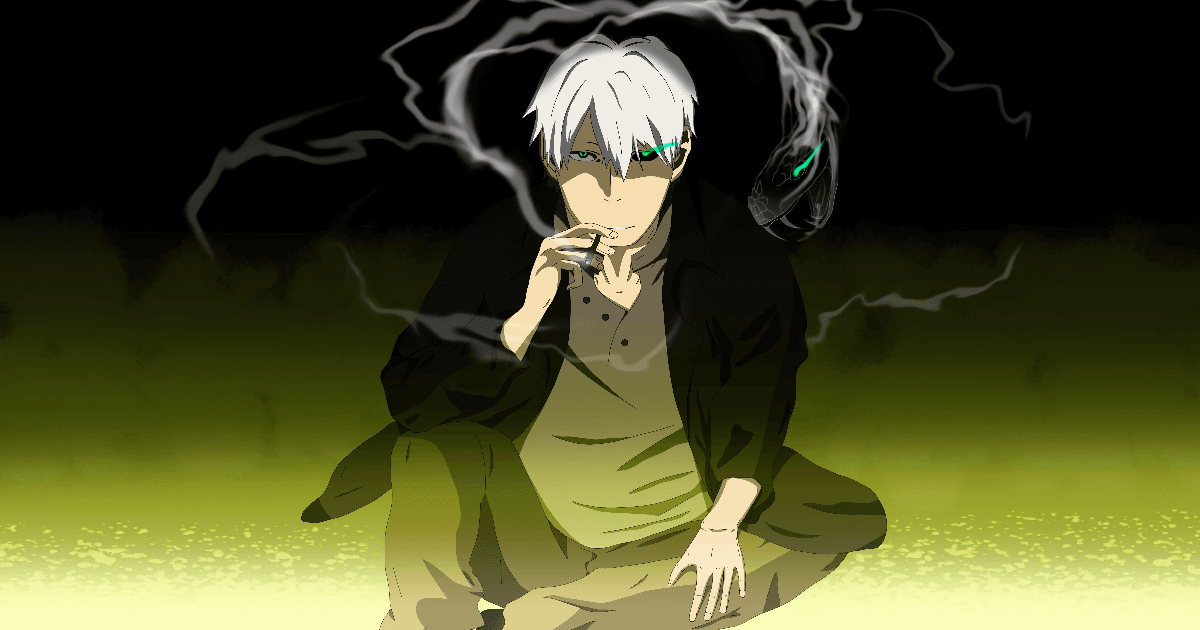
What has aged best, though, is the show's central register. Mushishi is an anime about a man who travels through a quasi-historical Japan investigating supernatural phenomena, and at no point does the show treat any of this as a problem to be solved. The mushi — life-forms more primitive than animals or plants — are not antagonists. The travelling protagonist Ginko is not a hero. The episodes do not arc toward resolution. The show's argument, twenty years later, looks more correct than it did when it was new: most of the things that hurt people are not problems with solutions; they are conditions to be lived with.
The structure: a stranger and a household
Each episode of Mushishi follows roughly the same shape. Ginko, a wandering mushi-shi (a kind of itinerant naturalist-priest) arrives at a household — a farmer's home, a fisherman's cove, a mountain village — that has been affected by mushi. He observes, he asks questions, he sometimes intervenes. By the end of the episode the affected family has either understood what was happening or learned to live with it. Ginko leaves. We almost never see him return.
The format is closer to a Chekhov short story collection than a serialised anime. There is no recurring antagonist. There are very few recurring side characters. Ginko himself, despite being the protagonist of every episode, is only barely a character with an arc — the show shows us his backstory in two specific episodes and otherwise leaves him as a relatively impersonal observer.
What this structure produces, over forty-six episodes plus the final film, is something rare. The audience is asked to be the recurring presence. The show's emotional continuity is not Ginko's — it is the viewer's, accumulating households over time, each lit by a different family's grief.
What loneliness looks like in Mushishi
The show's defining theme is, depending on which essay you read, "isolation," "asynchrony," "the gap between two living things," or "the way nature does not arrange itself to be understood by humans." In practice these are all the same theme. It is the loneliness specific to two beings who exist in different conditions — humans and mushi, of course, but also adults and dying children, parents and children with disabilities, returning soldiers and the families who waited for them, and, more often than is acknowledged, two adults who simply cannot reach each other across the years they were apart.
Episode 12, The Sleeping Mountain, is the show's most direct articulation of this. The episode is about a mountain god whose body is too large for a single human lifespan. The man chosen to inherit her role accepts that he will live for a thousand years and watch his family die, generation after generation, in front of him. The show does not present this as a tragedy. It presents it as a fact, observed by Ginko, whose tone is somewhere between scientific and rueful. The mountain god is lonely. The man is lonely. The mountain itself, the show implies, may also be lonely. There is no bad guy. There is just a long, patient understanding that some living things have to be alone in this specific way for the whole arrangement to keep working.
Why this style of loneliness is hard to write
Most anime that take on isolation as a theme treat it as a problem to be cured by friendship — the basic Shōnen Jump argument, but also the basic argument of most slice of life. Mushishi refuses this almost entirely. Ginko helps people, but he does not become friends with them. He stays at most a week. He explicitly tells his hosts that he must keep moving — his presence attracts mushi, and a settled mushi-shi is dangerous to the people around him. He drinks tea, listens, does what he can, and continues on.
The structural choice — keep the protagonist mobile, keep the cast rotating — is what makes the show's argument about loneliness possible. If Ginko had a recurring friend group, the show would inevitably drift toward the cure-by-friendship register. By keeping him alone, the show is able to argue that some kinds of solitude are not failures of community but are necessary to the work being done.
This is, in 2025-2026, an almost philosophically out-of-fashion argument. Most contemporary slice of life and adult-themed anime are committed to the proposition that adults heal in groups. Mushishi's answer is more careful: some people heal in groups, some people heal by walking, and some people simply walk because the walking is what they do. None of these are presented as superior to the others.
The score and the use of silence
Toshio Masuda's score for Mushishi is built largely from breath, wood, string and silence. The score's most-used instruments are koto, shakuhachi, biwa and a sustained low pad that functions almost as a substitute for room tone. Episodes routinely run for three to four minutes without dialogue and without scored music — only ambient sound and breath. This is unusual for any television anime, much less one with a forty-six-episode run.
The discipline pays off in specific scenes. Episode 7's underwater sequence, in which a young woman who has been turned into a mushi swims down to a lake bottom, is filmed in near-silence. The visual is gorgeous and there is no music at all underneath it. The choice not to score the scene is the point: the quiet is the experience. Most modern anime would have laid a piano line over the same shot. Mushishi trusts the silence enough to let it carry the moment.
Why it has aged so well
Most anime from 2005 looks dated now. Mushishi doesn't, for three reasons:
- The art direction is committed to a single colour palette. The show is largely browns, greens, blues and warm whites. There is almost no saturated red or magenta. There are no neon pinks. This is partly a function of the manga's palette and partly a deliberate choice; either way, it doesn't look like 2005 because it doesn't look like any decade.
- The character animation is restrained. Ginko walks, sits, crouches, drinks tea. He doesn't pose. The animation budget is spent on facial expressions and on the mushi themselves. As a result, the show doesn't carry the visual tics of the era — there are no fan-service composition choices, no era-specific shot transitions.
- The themes don't expire. The show is about loneliness, illness, asynchrony and the impossibility of fully understanding another living thing. None of these problems have been solved in twenty years.
Where to start in 2026
If you have never watched Mushishi, start with Episode 1 — The Green Throne. It is a fully self-contained twenty-five-minute story about a child who can see the world's spirits in a way the adults around him cannot. By the end of it you will know whether the show's tone works for you. If it does, you have forty-five more episodes plus the two-part film waiting for you, and you can watch them in any order — the show is intentionally non-serial.
The two-part film, Mushishi: The Next Chapter — Path of Thorns, was originally aired between the show's second-season halves and is included in most current streaming releases as Episode 21 of the 2014 run. It is the closest thing the franchise has to a finale. We recommend saving it for last.
Last updated: April 2026.