Spoiler scope: No story spoilers; visual references only.
If you have watched Demon Slayer, the Fate trilogies, the Tales of game cinematics, or Katsugeki/Touken Ranbu, you have watched ufotable. The studio is, by 2026, one of the most recognisable production houses in television anime — but the recognisability is technical rather than aesthetic. Their character designs vary widely across projects. What does not vary is the way they animate, composite and render scenes. There is a ufotable house style, and it is genuinely unusual in the Japanese animation industry.
This piece is for readers who have noticed that Demon Slayer looks different from other shōnen and want to know why. The short answer is "they composite differently from everyone else." The longer answer is below.
What "compositing" means here
In modern television anime production, compositing is the stage at which separately produced layers — drawn 2D characters, hand-painted backgrounds, 3D models, effects animation, lighting passes — are combined into a final image. Compositing happens in software (often After Effects) and is, in most studios, a relatively quick technical step.
At ufotable, compositing is treated as a creative phase comparable to key animation. The studio has its own large internal compositing department and uses custom in-house tools. The result is that a single ufotable shot typically passes through more digital layers — particle effects, lighting, depth-of-field, atmospheric haze, motion blur — than a comparable shot at a contemporary studio.
You can see this in any Demon Slayer action sequence. The "Water Breathing" effects are not animated as flat 2D loops — they are 3D simulations rendered with hand-tuned shaders, then painted over by 2D animators to give them line work, then re-composited to fit the lighting of the surrounding scene. The result reads as 2D to the eye and behaves as 3D in space.
The "2.5D" character problem and ufotable's solution
Most studios that try to combine 2D character animation with 3D environments encounter the same problem: the characters look pasted onto the backgrounds. The lighting on the character's hair doesn't match the lighting on the wall behind them; the perspective of the room doesn't match the perspective of the character; in motion, the character's "weight" feels different from the camera's weight.
ufotable's solution is to render the 3D environment first, sample its lighting, and then ask the 2D character animators to draw with that lighting in mind. The character cels are then run through compositing passes that add atmospheric haze, lens distortion and ambient occlusion to match the 3D environment. The character is, in effect, "lit" by the 3D environment after the fact.
This is why Demon Slayer's long lateral camera moves — particularly in the train sequence in Mugen Train — work without breaking the eye. The characters are drawn as 2D, but they are composited as if they were 3D. The camera moves around them at any angle and they continue to read as inhabiting the same space.
Why the Fate trilogy looks different from other action anime
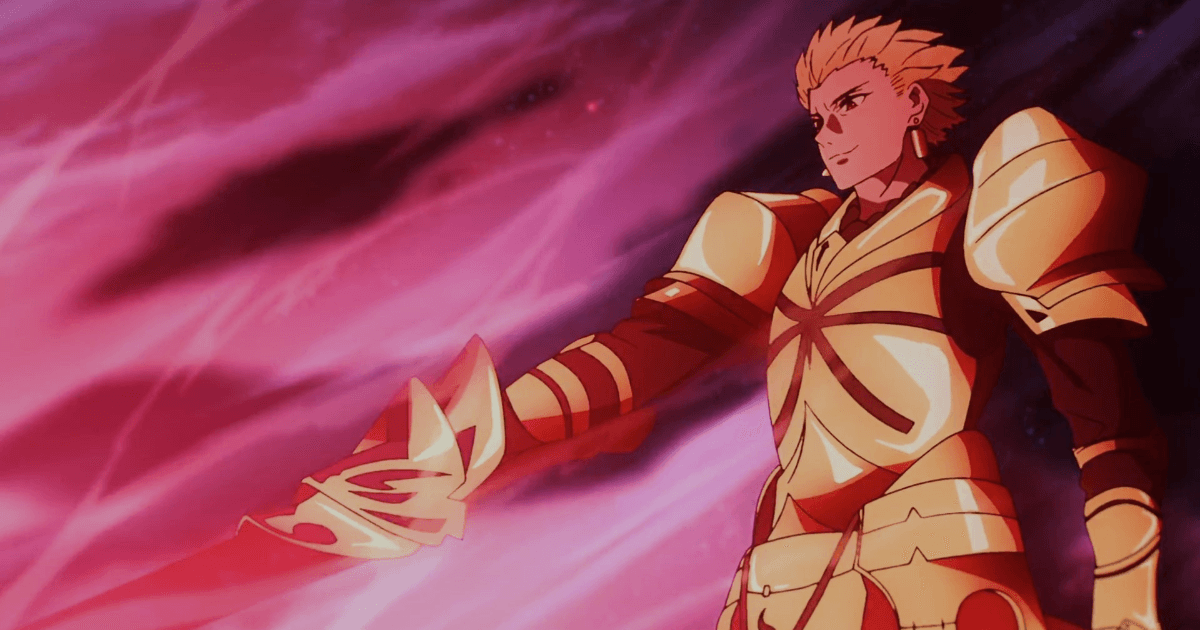
The earlier expression of the same technique is the Fate/Zero and Fate/stay night: Unlimited Blade Works productions. The Holy Grail War battles are some of the most architecturally complex action scenes in television anime — they almost always take place in elaborate 3D environments (cathedrals, Einzbern castles, Kotomine Church) that the camera moves through aggressively.
What ufotable does in these productions is hand the architectural complexity to the 3D department, the choreography to the 2D department, and the join between them to compositing. The result is an action sequence that has both modern 3D camera fluidity and traditional 2D character expression. Most studios pick one. ufotable is one of the few that has built a pipeline to do both routinely.
The light bulb test
If you want to see the studio's house style in a single thirty-second test, watch any scene in any ufotable show that contains a practical light source — a lantern, a fire, a window, a chandelier. Look at how the light interacts with the character's hair and skin, and look at how it interacts with the floor, the walls and the camera lens.
In a typical television anime production, the light source is a piece of background art. In a ufotable production, the light source is a lighting unit that propagates through the entire shot — bouncing off surfaces, casting soft shadows, leaking into the lens as bloom. Hair gets a coloured rim light from the lantern. Walls get a graded shadow as a character passes in front of the source. The camera, occasionally, gets a deliberately stylised lens flare.
This is the look most viewers describe as "cinematic." It is, technically, the result of a much heavier lighting pass than most studios use.
The cost of the pipeline
The ufotable pipeline is expensive in both money and time. A single episode of Demon Slayer reportedly takes two to three times the production schedule of an equivalent shōnen episode at a conventional studio. The studio compensates by owning every stage of production — they have their own theatres, distribution arm, internal compositing department, and integrated post-production team.
This vertical integration is rare in the industry. Most studios outsource at least one of background art, 3D modelling, compositing, finishing or post-production. ufotable does almost none of these externally. The result is consistency — every frame of Demon Slayer looks like it was made by the same team because, mostly, it was — but it limits the number of projects the studio can work on simultaneously.
This is why ufotable's release schedule is, by industry standards, slow. They produce roughly one major TV project per year and one or two films. They do not run multiple parallel productions in the way Madhouse, MAPPA or Wit Studio sometimes do.
What the house style is suited to and what it isn't
The ufotable approach is at its strongest in two specific contexts:
- Architectural action. Fights in churches, castles, mountains, train carriages — anywhere the environment is a load-bearing visual element. Mugen Train, the Hashira Training arc, the Heaven's Feel Lancer fights.
- Atmospheric quiet. Long, lit, almost-still shots of a character standing in a single illuminated space. The opening of Heaven's Feel I, the lantern sequences in Demon Slayer's Swordsmith Village arc.
It is less well-suited to dialogue-heavy slice of life or comedic shōnen. The pipeline produces a slightly heavier, more deliberate visual register than is needed for most school-life or rom-com shows; the studio is, accordingly, almost never asked to make those shows.
How to spot ufotable in the next thing you watch
A short checklist:
- Practical light sources cast lighting on characters, not just on backgrounds.
- The camera moves around 3D environments at angles that would be expensive to draw frame-by-frame.
- Effects animation (water, fire, blood) has a 3D-volumetric feel but reads as 2D linework.
- Backgrounds have noticeable atmospheric perspective — distance reads as haze, not just smaller objects.
- Action scenes are staged with extended single-take camera movements rather than rapid cuts.
If a show ticks four of those five, you are probably watching ufotable. The fifth is almost certainly an editing decision they made on a single shot.
Last updated: April 2026.